Thursday, September 01, 2011

Hotel Green Park scores yet again


Whether Madras Week celebrations received overwhelming or muted response this year, activities at Hotel Green Park, Vadapalani, went on an even keel and the response, like in previous years, was quite overwhelming and encouraging. There were quite a few who had travelled long distances to reach the venue and it was only after the clock struck eight that some began to slowly wend their way back home.

As usual it was the programme for children that set the tone for the evening. When Binita and Shrimati of Spring into Reading set about the task a few years ago, organising events for children during Madras Week, little would they have imagined the kind of response the events would generate. When Gargi of Zoom Kids joined this year, the three, under the Spring and Zoom (an activity centre for children) banner, made the most of an afternoon, welcoming children to experiment and create products using the potter’s wheel and palm leaves. Supported by resource persons from DakshinaChitra, ‘Madras – experience your cultural heritage’ was open to children five years and above.

Later, there was a peppy demonstration by the students, of ‘Madras: Then and now’, complete with song, dance and theatre, touching upon aspects such as traditional games and how children spend their time today compared to those in the past.

For Chithra Madhavan, Hotel Green Park is almost home. She has lectured here on two previous occasions. This year, she chose to make a presentation on ‘Lesser known temples of Chennai – some more’. As usual, hers was a thoroughly researched presentation, pleasing to the ear and easy on the eye. It’s indeed a shame that many of our old temples remain neglected with inscriptions scraped away and gaudy paint plastered over. Chithra points this out time and again, which only shows that it must be the same story in many temples and how it has impacted a lover of heritage like her.

Incidentally, Chithra completed her M.A. and M. Phil. from the Department of Indian History, University of Madras and her Ph.D. from the Department of Ancient History and Archaeology, University of Mysore. She has published five books - History and Culture of Tamil Nadu (in two volumes) and Vishnu Temples of South India (in three volumes). She has also co-edited a book South India Heritage which contains 500 articles on various aspects of South India’s heritage and culture.

Pradeep Chakravarthy made quite an interesting presentation, on how ‘Kodambakkam (Puliyur) was the centre of Madras’. He took a look at how Madras was organised geographically in the 9th-12th centuries, what some troublesome local governance issues were and how they were resolved. There is very little about Puliyur in the public domain and based on what Pradeep explained, there is a whole world out there that needs to be researched. It only shows how little we know about our own local history. Pradeep’s attempt I thought was remarkable simply because there is so little material to base a presentation like his on. I would urge him to conduct research himself, if he can. That might form the background to an interesting book.

Pradeep has two books to his credit – on Thanjavur and the Vahanas. A student of KFI and a graduate from Madras Christian College, Jawaharlal Nehru University and the London School of Economics, he is an executive coach for senior leaders in Infosys Technologies. His articles appear frequently in The Hindu and Business Line.

Pictures show some children waiting expectantly as a little girl gets her fingers thoroughly soiled on the potter’s wheel; a resource person from DakshinaChitra showing a boy how he can be creative with palm leaves; children from the local Corporation school show off their exhibits; a father and daughter look for something interesting to read as Malavika from Book and Borrow looks on; and a packed hall at Green Park.


Sunday, August 28, 2011

Yet another unsung hero (A. Ananda Kumar)


Probably the youngest hero of Madras Week was A. Ananda Kumar who exhibited his paintings at the C.P. Ramaswami Aiyar Foundation. Kumar graduated this year from the Government College of Fine Arts, Chennai and is the first degree holder in Fine Arts from his village Koralpakkam in Thiruvannamalai District.

When I visited the g Vennirul Art Gallery there was no visitor. The lights were off and somebody came to switch them on as I entered. The sad part in some of these exhibitions is that there are hardly enough people interested in coming to see what’s on offer.

Whether it’s the C.P. Ramaswami Aiyar Foundation or the Gallery Sri Parvati or other galleries, it all looks good for the record, to have exhibits during Madras Week, but in reality, except for the inaugural if there is one, you will hardly find people coming. Lakshmi Venkataraman, who runs Gallery Sri Parvati, has echoed my view many times. She should know. Her gallery, done up fairly well, in the centre of the city, in Alwarpet, does not attract many visitors during Madras Week.

So, I had the whole Vennirul Art Gallery to myself and spent some time looking at the exhibits before an officer from the Foundation trooped in, probably signaling that my time was up.

Outside I was pleasantly surprised to see Ananda Kumar immersed in what he does best – paint. As he wielded his brush, his eyes were focused on an old building on the campus, probably one that might have been the residence of Sir C.P. Ramaswami Aiyar.

Pictures show some of Kumar’s work – the flow of the Cooum against a backdrop of heritage buildings, of St Andrew’s Church and Victoria Public Hall, and of the Mylapore Temple tank. I managed a picture of Kumar even as he was providing final touches to his painting of the building that formed the background.

Saturday, August 27, 2011

A flavour of early 20th Century Madras


Last year, Nanditha Krishna of the C. P. Ramaswami Aiyar Foundation had organised during Madras Week an exhibition on Fort St. George. The exhibition included aquatints, etchings and engravings from private collections, maps and sketches.

This year, she had two exhibitions running – one, a display of paintings by A. Ananda Kumar and the other, a display of some splendid photographs taken by the late M. K. Rangaswamy Aiyangar – of Madras and its environment in the beginning of the last century.

Let’s look at Aiyangar’s pictures first. M. K. Rangaswamy Aiyangar was a prolific writer and photographer. Born in 1886 in Srivilliputhur, he was a scholar of art, culture, religion and music, having written many articles on the subjects in leading dailies like The Hindu, Indian Express and the weeklies and magazines of his times. He authored several books, among which Thyagaraja Thatvam and Mahabalipuram – A Guide Book with illustrations of photographs taken by him are noteworthy.

Aiyangar was an eminent photographer and, according to Nanditha, will be remembered for his famous photographs of the early 20th century Madras and Tamil Nadu, especially the temples. Tirumala to Tillai, his famous exhibition of pictures, was held in Madras, Tirunelveli and Kalahasti in Andhra Pradesh.

Aiyangar’s son, the late R. Madhavan, who retired from The Hindu, gifted his father’s collection of negatives and prints to the C. P. Ramaswami Aiyar Foundation library.

Here are a few of Rangaswamy Aiyangar’s pictures: a long-shot view of some of the pictures of monuments, of the Sri Thyagarajar Temple in Thiruvottriyur, of a person feeding vultures in Thirukkalukundram, of the Sangu Thirtham Tank there, and of the St Thomas Church on the Little Mount.

Friday, August 26, 2011

Other unsung heroes (John Moses, Winston Henry, Venkatesh)


It appears kerosene was first imported to Madras by Best & Company in 1879. It was sold in tins by the brand names Chester and Monkey. Kerosene lamps were also sold on carts till the late 1970s. With the import of kerosene from abroad, lamps from England, Germany, Hungary, France, Japan and the United States followed. According to John Moses, who had an astonishing display of lamps at the Padma Seshadri School in KK Nagar, the lamp industry was highly competitive in these countries – in producing lamps, wicks, chimneys and globes. Most of the lamps then were made of brass, glass and porcelain.

Moses and Winston Henry (who helps put up aquariums and aviaries), narrated at length their passion for collecting anything old. Moses said his collection of old lamps, watches, pens and cycles was so large that there was hardly enough space at his home in Kilpauk to keep them. “My family just manages to tolerate me,” he said.

Winston said just about the same thing. The passageways in his house are lined with large containers filled with old books. He had brought along the 1870 edition of Francis Buchanan’s ‘Journey from Madras through the countries of Mysore, Canara and Malabar’, published by Higginbotham and Company, Madras. The pages were almost falling apart and the years had taken its toll – but you were taken to another world just by grasping the book.

Together, Moses and Winston made a difference to the exhibition at the school. They also took pains in describing the displays to all those who seemed interested to know and learn more.

Another participant who needs special mention was Venkatesh, a peon at the Padma Seshadri School. He has been an avid collector of coins and has always sought an outlet to exhibit them. Two years ago, he came up with a similar display. School duties have not blunted his enthusiasm to pursue his hobby. His is an example many should follow.

And these are the people who make Madras Week what it is. They toil hard all day long, expect little publicity, prefer to keep a low profile, are happy with even the smallest word of appreciation, and treat every person with dignity.

Pictures show Moses before his prized collection, Winston going about his job of explaining to visitors, Francis Buchanan’s book, a coloured illustration on one of the pages of the book, and Venkatesh beaming before his collection.

Thursday, August 25, 2011

An unsung hero: S.A. Govindaraju


The Madras Heritage Lovers Forum put up a wonderful show at the Padma Seshadri School in KK Nagar. Most of the members are past 50, with consultant architect D.H. Rao, who organised and ‘choreographed’ the entire show, well past 70. More than anything, it was rare commitment on display, a passion for a city and its heritage.

The forum is made up of Rao, V. Prabhakar, Winston Henry, S.A. Govindaraju, who has an amazing collection of old books and magazines, John Moses, Lazer, Roland Nelson and Hemant Chopra. Some of them were there throughout at the three-day event, standing for the most part in a hall without the air-conditioning system turned on.

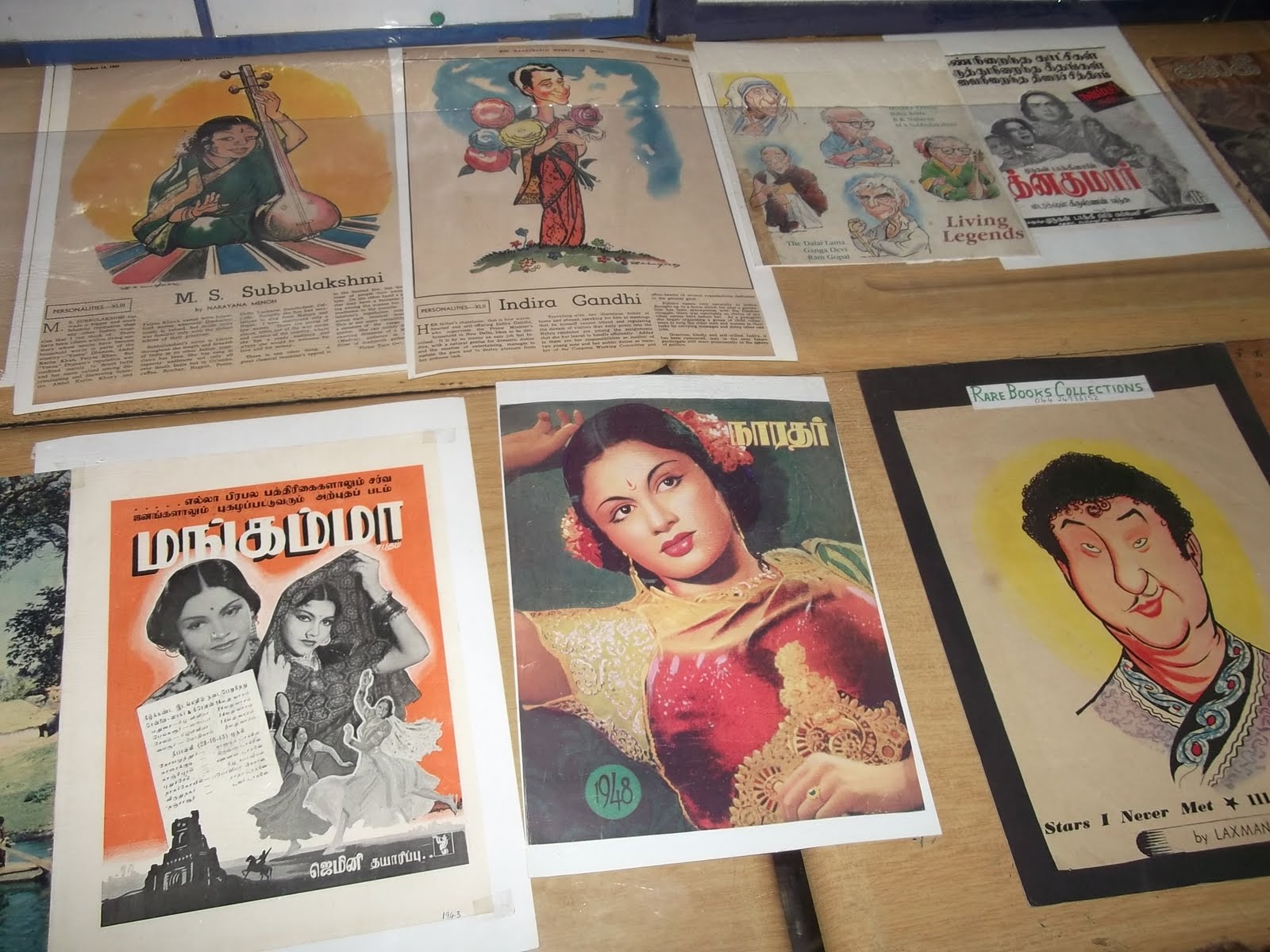
Govindaraju is 80 years old but his passion for old books and magazines hasn’t diminished a bit. He has been collecting them for more than four decades and has over 5000 books and 10000 magazines, paper clippings and advertisements. A retired labour law consultant, he runs a small garage where he sells these books. What is remarkable is that he is able to identify each of the books just by the look of them – the author and publisher’s names, even the date of publication.

Govindaraju has books on law, philosophy, literature, history, wildlife, poetry, encyclopedias and books on film stars and politicians. He has a large collection of R.K. Laxman’s cartoons as well.

Every day, he spends his time in the garage (Rare Books, R.A. Puram, 2nd Main Road) with his collection, waiting for people with a similar passion, a passion that is hard to find these days.

Pictures show some of the material on display – Manohar Devadoss’s exquisite s pen-and-ink drawings; Govindaraju’s books; and one (Madras – Chennai Pattinam) of several fascinating articles by Nanditha Krishna (director of the C.P. Ramaswami Aiyar Foundation) that had appeared in The Illustrated Weekly of India in the 1970s.