Sunday, August 28, 2011

Yet another unsung hero (A. Ananda Kumar)


Probably the youngest hero of Madras Week was A. Ananda Kumar who exhibited his paintings at the C.P. Ramaswami Aiyar Foundation. Kumar graduated this year from the Government College of Fine Arts, Chennai and is the first degree holder in Fine Arts from his village Koralpakkam in Thiruvannamalai District.

When I visited the g Vennirul Art Gallery there was no visitor. The lights were off and somebody came to switch them on as I entered. The sad part in some of these exhibitions is that there are hardly enough people interested in coming to see what’s on offer.

Whether it’s the C.P. Ramaswami Aiyar Foundation or the Gallery Sri Parvati or other galleries, it all looks good for the record, to have exhibits during Madras Week, but in reality, except for the inaugural if there is one, you will hardly find people coming. Lakshmi Venkataraman, who runs Gallery Sri Parvati, has echoed my view many times. She should know. Her gallery, done up fairly well, in the centre of the city, in Alwarpet, does not attract many visitors during Madras Week.

So, I had the whole Vennirul Art Gallery to myself and spent some time looking at the exhibits before an officer from the Foundation trooped in, probably signaling that my time was up.

Outside I was pleasantly surprised to see Ananda Kumar immersed in what he does best – paint. As he wielded his brush, his eyes were focused on an old building on the campus, probably one that might have been the residence of Sir C.P. Ramaswami Aiyar.

Pictures show some of Kumar’s work – the flow of the Cooum against a backdrop of heritage buildings, of St Andrew’s Church and Victoria Public Hall, and of the Mylapore Temple tank. I managed a picture of Kumar even as he was providing final touches to his painting of the building that formed the background.

Saturday, August 27, 2011

A flavour of early 20th Century Madras


Last year, Nanditha Krishna of the C. P. Ramaswami Aiyar Foundation had organised during Madras Week an exhibition on Fort St. George. The exhibition included aquatints, etchings and engravings from private collections, maps and sketches.

This year, she had two exhibitions running – one, a display of paintings by A. Ananda Kumar and the other, a display of some splendid photographs taken by the late M. K. Rangaswamy Aiyangar – of Madras and its environment in the beginning of the last century.

Let’s look at Aiyangar’s pictures first. M. K. Rangaswamy Aiyangar was a prolific writer and photographer. Born in 1886 in Srivilliputhur, he was a scholar of art, culture, religion and music, having written many articles on the subjects in leading dailies like The Hindu, Indian Express and the weeklies and magazines of his times. He authored several books, among which Thyagaraja Thatvam and Mahabalipuram – A Guide Book with illustrations of photographs taken by him are noteworthy.

Aiyangar was an eminent photographer and, according to Nanditha, will be remembered for his famous photographs of the early 20th century Madras and Tamil Nadu, especially the temples. Tirumala to Tillai, his famous exhibition of pictures, was held in Madras, Tirunelveli and Kalahasti in Andhra Pradesh.

Aiyangar’s son, the late R. Madhavan, who retired from The Hindu, gifted his father’s collection of negatives and prints to the C. P. Ramaswami Aiyar Foundation library.

Here are a few of Rangaswamy Aiyangar’s pictures: a long-shot view of some of the pictures of monuments, of the Sri Thyagarajar Temple in Thiruvottriyur, of a person feeding vultures in Thirukkalukundram, of the Sangu Thirtham Tank there, and of the St Thomas Church on the Little Mount.

Friday, August 26, 2011

Other unsung heroes (John Moses, Winston Henry, Venkatesh)


It appears kerosene was first imported to Madras by Best & Company in 1879. It was sold in tins by the brand names Chester and Monkey. Kerosene lamps were also sold on carts till the late 1970s. With the import of kerosene from abroad, lamps from England, Germany, Hungary, France, Japan and the United States followed. According to John Moses, who had an astonishing display of lamps at the Padma Seshadri School in KK Nagar, the lamp industry was highly competitive in these countries – in producing lamps, wicks, chimneys and globes. Most of the lamps then were made of brass, glass and porcelain.

Moses and Winston Henry (who helps put up aquariums and aviaries), narrated at length their passion for collecting anything old. Moses said his collection of old lamps, watches, pens and cycles was so large that there was hardly enough space at his home in Kilpauk to keep them. “My family just manages to tolerate me,” he said.

Winston said just about the same thing. The passageways in his house are lined with large containers filled with old books. He had brought along the 1870 edition of Francis Buchanan’s ‘Journey from Madras through the countries of Mysore, Canara and Malabar’, published by Higginbotham and Company, Madras. The pages were almost falling apart and the years had taken its toll – but you were taken to another world just by grasping the book.

Together, Moses and Winston made a difference to the exhibition at the school. They also took pains in describing the displays to all those who seemed interested to know and learn more.

Another participant who needs special mention was Venkatesh, a peon at the Padma Seshadri School. He has been an avid collector of coins and has always sought an outlet to exhibit them. Two years ago, he came up with a similar display. School duties have not blunted his enthusiasm to pursue his hobby. His is an example many should follow.

And these are the people who make Madras Week what it is. They toil hard all day long, expect little publicity, prefer to keep a low profile, are happy with even the smallest word of appreciation, and treat every person with dignity.

Pictures show Moses before his prized collection, Winston going about his job of explaining to visitors, Francis Buchanan’s book, a coloured illustration on one of the pages of the book, and Venkatesh beaming before his collection.

Thursday, August 25, 2011

An unsung hero: S.A. Govindaraju


The Madras Heritage Lovers Forum put up a wonderful show at the Padma Seshadri School in KK Nagar. Most of the members are past 50, with consultant architect D.H. Rao, who organised and ‘choreographed’ the entire show, well past 70. More than anything, it was rare commitment on display, a passion for a city and its heritage.

The forum is made up of Rao, V. Prabhakar, Winston Henry, S.A. Govindaraju, who has an amazing collection of old books and magazines, John Moses, Lazer, Roland Nelson and Hemant Chopra. Some of them were there throughout at the three-day event, standing for the most part in a hall without the air-conditioning system turned on.

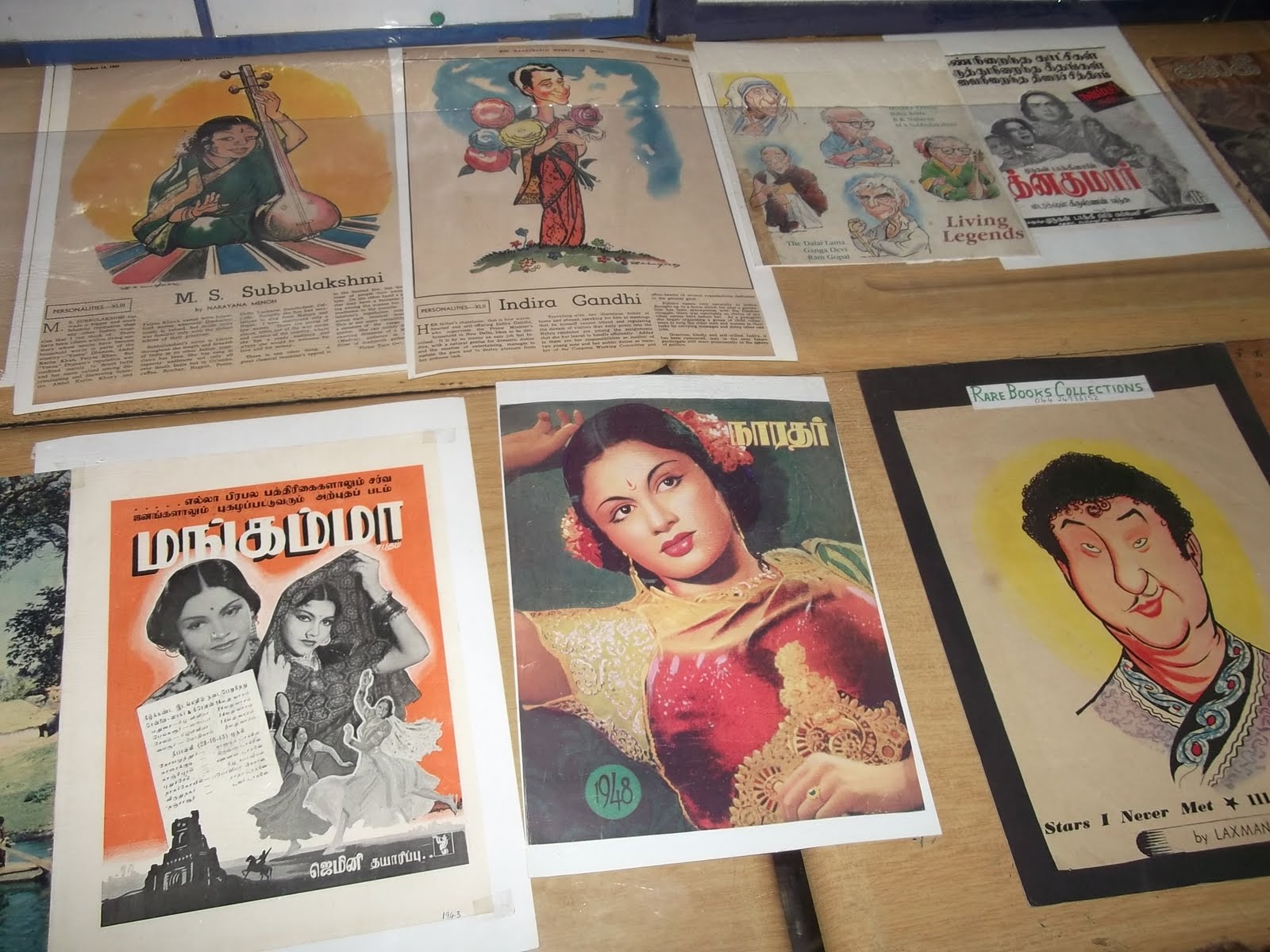
Govindaraju is 80 years old but his passion for old books and magazines hasn’t diminished a bit. He has been collecting them for more than four decades and has over 5000 books and 10000 magazines, paper clippings and advertisements. A retired labour law consultant, he runs a small garage where he sells these books. What is remarkable is that he is able to identify each of the books just by the look of them – the author and publisher’s names, even the date of publication.

Govindaraju has books on law, philosophy, literature, history, wildlife, poetry, encyclopedias and books on film stars and politicians. He has a large collection of R.K. Laxman’s cartoons as well.

Every day, he spends his time in the garage (Rare Books, R.A. Puram, 2nd Main Road) with his collection, waiting for people with a similar passion, a passion that is hard to find these days.

Pictures show some of the material on display – Manohar Devadoss’s exquisite s pen-and-ink drawings; Govindaraju’s books; and one (Madras – Chennai Pattinam) of several fascinating articles by Nanditha Krishna (director of the C.P. Ramaswami Aiyar Foundation) that had appeared in The Illustrated Weekly of India in the 1970s.


Wednesday, August 24, 2011

More spontaneity, energy needed

After seven years of playing the catalyst role in putting events together in some places, I get the feeling that a lot of it is not as spontaneous as it would seem to be. We’ve had two press conferences – one in June to announce broadly the celebration, and the second a week ahead of Madras Week, to drive home the specifics. What if we, the catalysts or coordinators, did not convene the press meets – would we then have had as many ‘celebrations’ of the city or events that are there now? My answer is ‘no’.

People, whether they be individuals, heading schools, colleges or institutions have to be pushed a bit to get events off the starting block. There’s only one school that seems to have earmarked Madras Day and Madras Week in the school calendar. So, why is the spontaneity missing? Does love of one’s city not amount to too much, or doesn’t heritage and allied subjects not rank high at all? I would say heritage does not rank high in a person’s list of priorities.

So, how do we get more people to celebrate the founding of a city? To the best of my knowledge, Chennai is perhaps the only city in India to have such a weeklong celebration bracketing its birthday. There are no straightforward answers to the question as much as there is no short-term solution. The best way is to instill the idea in the minds of schoolchildren from all schools so that when they grow up, they realise the value of protecting and conserving the heritage of the place where they spent their growing years.

The other point is that over the years we’ve been having the same people speaking at various forums. Of course, it’s a pleasure to listen to city historians S. Muthiah and Randor Guy and V. Sriram but we need many others who can speak or make presentations on a variety of other subjects connected to the city. Where are the Tamil speakers? Gnanai Sankaran, Badri Seshadri or Ashokamitran are fairly good speakers and people will come to hear them, but they, and I’m sure there are many more like them, are not part of the week’s celebrations this year. What I’m trying to say is that often it is the same message that goes out, from the same speakers. I think some of the older speakers must make way for new and younger ones.

Overall, it’s schoolchildren who are benefiting the most, from participating in quiz contests, essay and drawing competitions, in exhibitions, and by listening to speakers. The three-day exhibition of Madras memorabilia, put together by the Chennai Heritage Lovers Forum headed by the indefatigable D.H. Rao, at the Padma Seshadri School in KK Nagar was a success, with students from many neighbouring schools coming to have a look.

However, a rather disappointing note was struck at the Jaigopal Garodia School in Anna Nagar, when Chandrachoodan Gopalakrishnan failed to live up to expectations and rather than showing some of the hundreds of pictures he must have taken during his ‘photowalks’, decided to get teachers of the school to demonstrate how they took history classes. His larger message was to get schoolchildren out of the classrooms, a message that we have often heard, and the point was not lost. But if he had enough pictures to show or stories to tell it might have made up for something, but it wasn’t to be.